
 Featured
Green Marble Console Table
Marble · Green
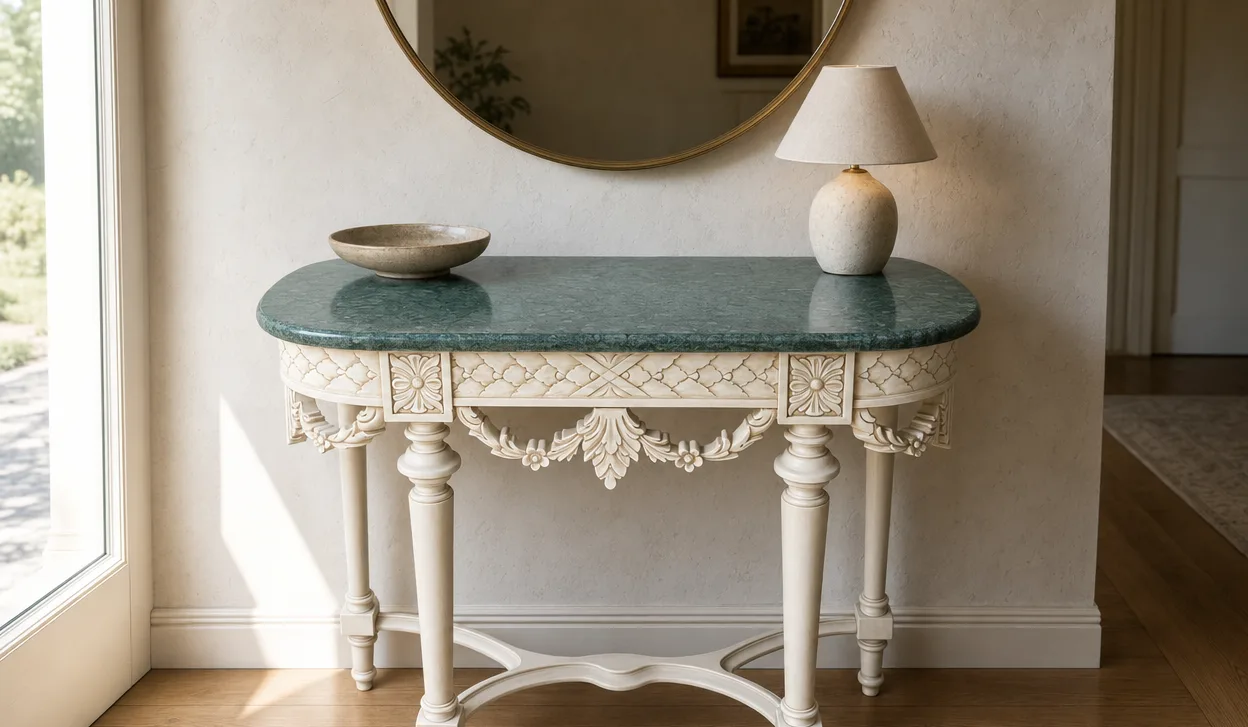
A green marble console top on a classically carved base. Brown and copper veins cross a green ground.
A stone top for existing furniture, or a single-piece stone console. High-character stone used across a small surface.
The console is a piece of work where the scale of stone use is small but the effect is high. A kitchen countertop means five square metres of surface; a console top does not exceed half a square metre. That smallness is not a constraint but an opportunity: stones of very high character — such as the green marble in this catalogue, which could be overwhelming across a large surface — sit at exactly the right scale on a console.
We work in two ways. First, a top for existing furniture: we prepare a stone top to size for a console, chest of drawers or classic carcass you already own. The green console in this catalogue belongs to this group — a green marble top over a carved white classic body. In this type of work the most important stage is measuring: the top surface of a furniture carcass is rarely a true rectangle, and its edges may be slightly curved or out of square. A top cut without taking a template will not sit on the furniture, and unequal overhangs will appear at the edges.
Second, a single-piece stone console: entirely stone including the body, an arrangement in which slabs are brought together into a box with 45-degree mitred joints. This is the same technique described for the fireplace; the corner appears as one thickness of stone and the console reads as a solid block. Being hollow inside keeps the weight within transportable limits.
The edge detail is the decision that determines a console's appearance. Over a classic carcass, a radiused or profiled edge agrees with the language of the furniture; in a contemporary arrangement a square edge is more correct. How far the top projects beyond the furniture also matters: a 1-2 cm overhang says the top belongs to the furniture, while a 5 cm overhang turns the top into a separate element.
Because a console is not a daily working surface, we are free in the choice of finish. A polished surface shows the vein most clearly, and on a console there is virtually no risk of acid. As it is a surface where vases and objects are placed, impregnation is still recommended; water and soil seeping from under a planter can leave marks on porous stones in particular.
Catalogue
Other areas