
 Featured
Green Marble Fireplace
Marble · Green
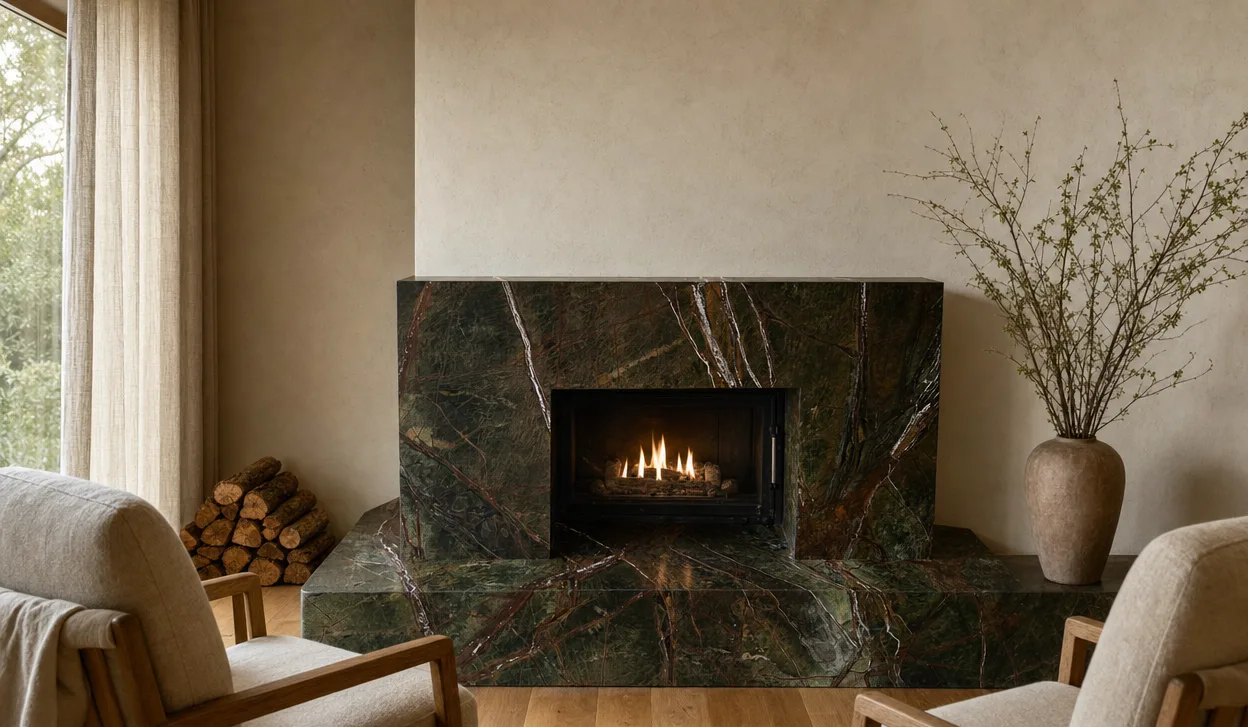
A green marble fireplace surround; a stepped hearth, thick-reading mitred joints and vein symmetry.
Fireplace cladding and single-body fireplace surrounds, with symmetrical veining through book-matched installation.
The fireplace is where stone is used most spectacularly in a room. A countertop or table is a horizontal surface; a fireplace stands vertical, at eye level, and usually at the focus of the room. Stone selection in fireplace work is therefore made from the stones with the strongest character, and the veining pattern is not left to chance.
The fireplace in this catalogue was made in a marble where brown and copper veins cross a green ground. The reason that stone was chosen is that its vein is directional: the vein is not randomly distributed but runs along particular lines. When you set two slabs facing each other like a mirror (book-matching), the vein forms a symmetrical pattern along the joint line. This gives the front face of the fireplace a symmetrical appearance built around a central axis. Book-matching requires the two slabs to be consecutive cuts from the same block, which is why slab supply on fireplace work has to be planned at the same time as the design.
The joint detail is critical in fireplace cladding. In the work shown here the body reads as a single block of stone; this is achieved by cutting all the corner joints at 45 degrees. In a mitred joint the thicknesses of two slabs taper towards the corner and meet, so the corner appears as one thickness of stone. In an overlapped butt joint the thickness of the upper slab is visible from the side and the cladding reads as cladding. The difference shows exactly where people look most once installation is finished.
Heat is the technical side of fireplace work. The stone surrounding the combustion chamber must not be directly exposed to flame; the thermal insulation gap specified by the appliance manufacturer between the firebox and the stone has to be observed. Stone expands with heat; to accommodate that expansion, flexible filler is left in the joints and the stone is fixed with an elastic rather than a rigid adhesive. Where these details are skipped, cracks show themselves by the end of the first winter.
On surface finish, polished is more often chosen for fireplaces, because a fireplace is not a working surface but a viewing surface: there is no risk of acid or scratching, so the advantage of polish showing the vein most clearly comes at no cost. On dark, characterful stones a patinato finish also gives a fine result, bringing the texture forward and removing the shine.
Catalogue
Other areas