
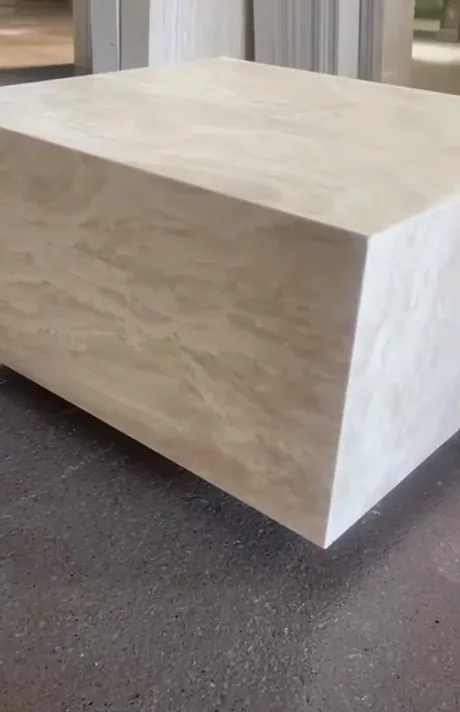
Travertine Coffee Table
Travertine · Travertine
A block-form travertine coffee table. Mitred joints give the effect of a single mass; the surface is left matt.
Coffee tables with a single-piece stone body or a stone top — as a thick-reading box form, or as a slim-top arrangement.
A coffee table stands in the middle of a seating group and is seen from every direction. This produces the same design problem as a kitchen island: there is no edge to hide. How the edges finish, where the joints fall and how the body sits reveal the quality of the whole piece.
The travertine coffee table in this catalogue is a box form: slabs held together with 45-degree mitred joints, the result reading as a solid block. The advantage of this arrangement is that it gives the sense of weight without the weight of the stone; being hollow, two people can carry it, yet its appearance is indistinguishable from a block cut in one piece. What is critical in a box form is the precision of the mitre: even a millimetre of deviation at the corner joint is visible to the naked eye, because light runs uninterrupted along the corner. The mitre cuts are therefore made by CNC in the workshop.
Travertine is a deliberate choice for this type of work. Across a large, closed surface a veined marble can be overwhelming; travertine's porous texture and horizontal bedding lines keep the surface calm and bring the form of the block forward. The direction of cut through the layers also changes the appearance here: a cut perpendicular to the bedding brings out the horizontal lines and gives the block a direction, while a parallel cut leaves a more clouded, directionless surface.
The alternative arrangement is a slim top on metal legs. This produces the opposite effect to the box form: the table looks light, the floor is seen beneath it and the room feels larger. In small seating groups this arrangement is more correct; a box form can weigh down a room whose dimensions do not support it.
A coffee table is a daily working surface. Glasses, plates, books and remote controls sit here, so the choice of finish follows the same logic as for a dining table. A honed surface forgives daily marks; a polished surface deepens the texture and the colour. With travertine there is also the filling choice: in a home where coasters are not used, the filled preparation is safer, because open pores hold liquid.
Catalogue
Other areas