
 Featured
Travertine Kitchen Island
Travertine · Travertine
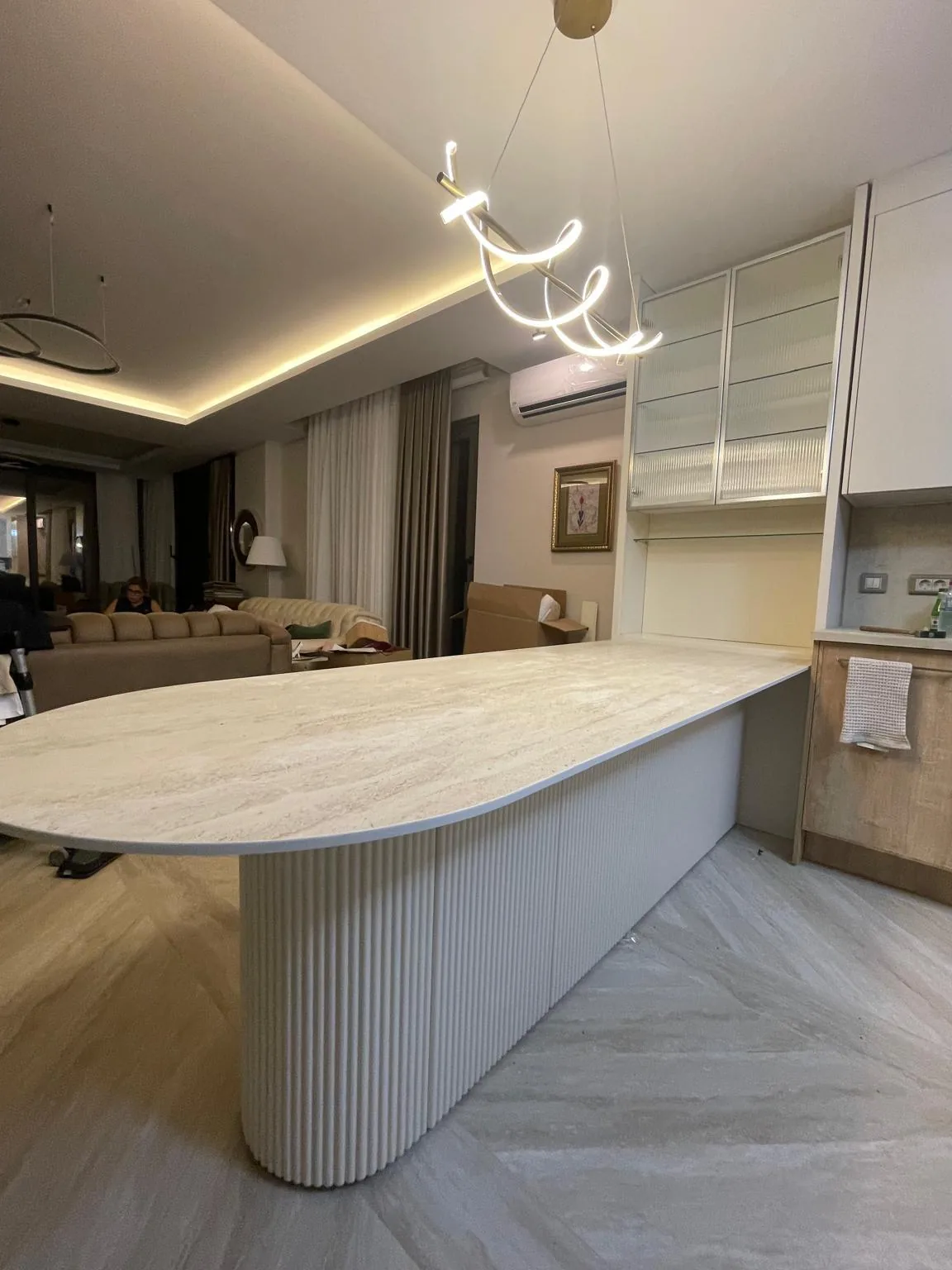
A half-oval travertine kitchen island; its front body clad in vertically fluted travertine strips, with a thick-reading top edge.
A single-piece island top visible from all four sides. Where the vein runs is decided before cutting.
The kitchen island parts company with the kitchen countertop at one point: all four of its sides are visible. On a countertop against a wall the slab's rear edge is hidden, joints can be thrown into a corner, and where the vein runs is secondary. With an island you have no such luxury. The top stands in the middle like a table, and every edge, every joint, every turn of the vein is seen.
For this reason the cutting decision on island work is taken not after the slab is chosen but while it is being chosen. In the workshop we lay the template over the slab and decide together where the vein will run within the top. A vein through the centre gives a symmetrical, calm result; a vein along the edge makes the island look livelier. In book-matched installation, where two slabs are set facing each other like a mirror, the vein must continue without interruption across the joint line — possible only when both slabs are consecutive cuts from the same block.
The detail most often asked about on islands is the side cladding. An appearance limited to the thickness of the top has a completely different effect from a stone surface running the full height of the island. Stone cladding to the floor (full side cladding) makes the island read as a single block; for this the side panels have to meet the top in a 45-degree mitred joint, so that the corner appears as one thickness of stone rather than two overlapping slabs. This joint is prepared in the workshop and only bonded on site.
The overhang is another dimension that has to be settled. The further the island top projects beyond the cabinet line, the more stools fit beneath it. An unsupported overhang is kept at around 25-30 cm; beyond that a steel profile or concealed bracket support is added. Settling this detail together with the cabinet maker matters if surprises are to be avoided at installation.
The island work in this catalogue uses travertine; travertine's porous texture reads calmer than a veined marble across large surfaces and does not overwhelm the rest of the kitchen. The same work can be done in a veined marble such as Calacatta; in that case the island becomes the focus of the kitchen and the cabinet colours need to step back.
Catalogue
Other areas