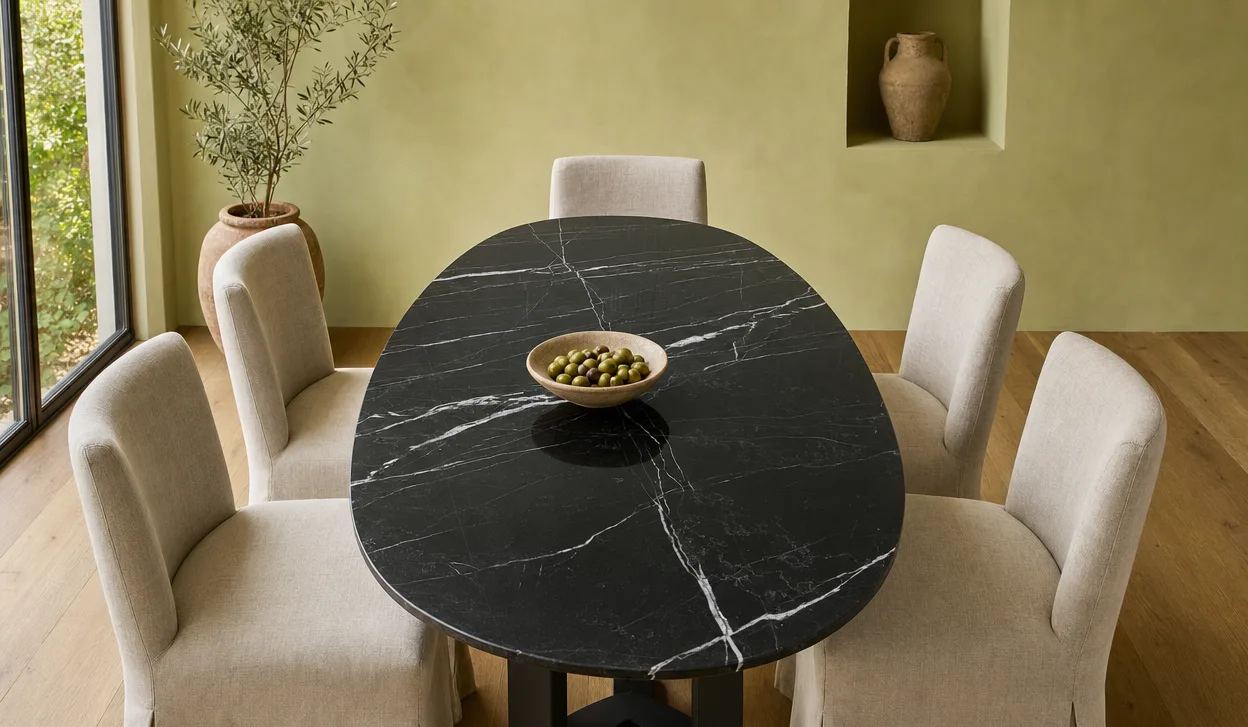
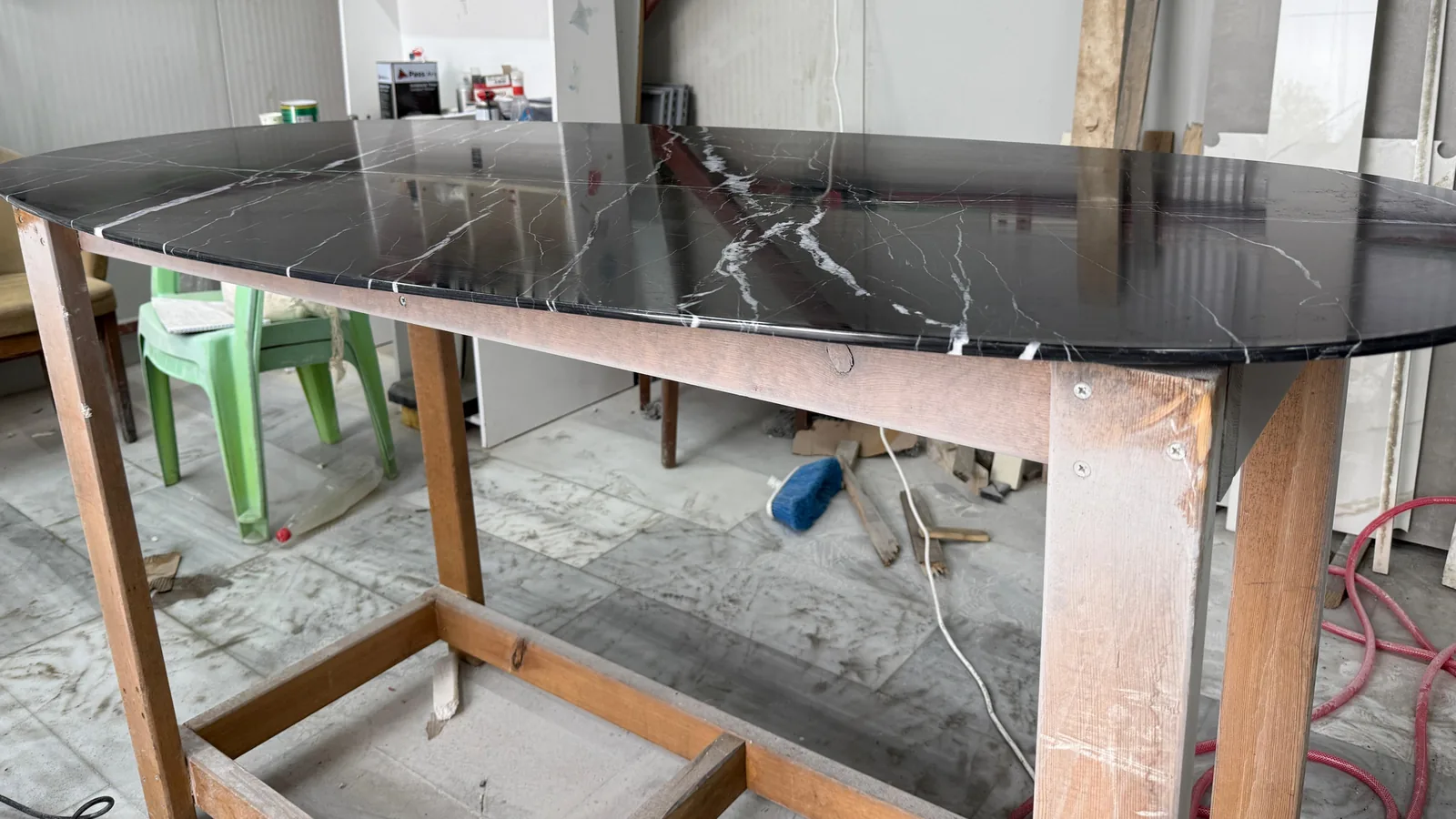
In black marble with white veining the vein stands like a drawing: fine, crisp and clearly directed. That clarity is an advantage on an oval top, because the curved edge does not sever the direction of the vein but instead forms a boundary around it.
The oval form is cut in a single pass; since the symmetry of the top depends on the machine path, no hand correction is needed. The edge was softened with a radius: at a dining table the first surface a seated person's arm meets is the edge of the top, and a sharp chamfer is uncomfortable in that contact. A strip of the same stone can be bonded beneath the top to give the appearance of a thicker mass; that choice is settled together with the base.
Black stone shows dust and fingerprints more clearly than pale stone. That visibility is highest on a polished surface and markedly lower when honed. It is also worth repeating that marble reacts with acid: lemon, vinegar or wine can locally remove the gloss from a polished surface. This is etching, not staining, and it is corrected by re-polishing.




 Featured